
When a patient is brought into the Intensive Care Unit (ICU) during an emergency, every second matters. The first 10 minutes are critical and can significantly impact the patient’s survival and recovery. During this time, a structured and well-coordinated ICU emergency process is followed to stabilize the patient and assess their condition quickly.
Many people are unaware of what actually happens during these crucial moments. In this blog, we will explain the step-by-step ICU emergency process that takes place in the first 10 minutes of admission.
Understanding the ICU Emergency Process
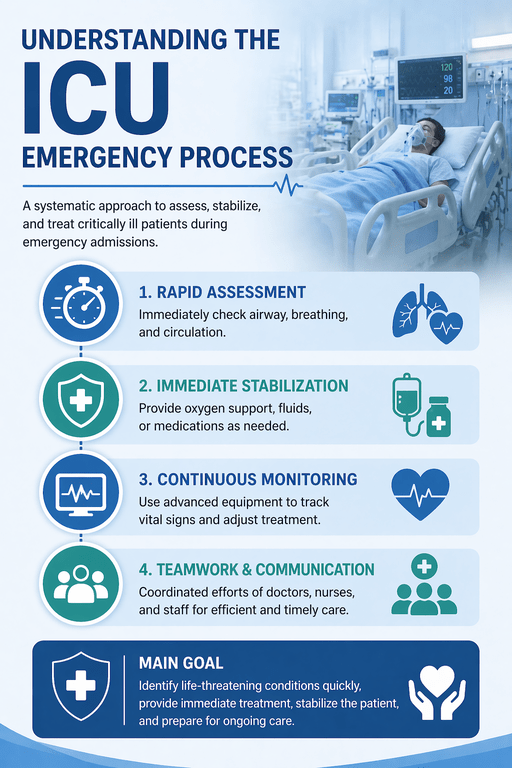
The ICU emergency process is a well-structured and systematic approach followed by healthcare professionals to manage critically ill patients during emergency admissions. This process is designed to ensure that every second is used effectively to assess, stabilize, and treat the patient. The ICU emergency process begins the moment a patient arrives and continues through every stage of care, focusing on rapid assessment, immediate intervention, and continuous monitoring.
In the first few minutes, the ICU emergency process prioritizes checking the patient’s airway, breathing, and circulation. These are the most critical life functions, and any delay in addressing them can lead to serious complications. Once these are assessed, the medical team quickly moves to stabilize the patient by providing oxygen support, fluids, or medications as needed.
Another important aspect of the ICU emergency process is continuous monitoring. Advanced equipment is used to track vital signs such as heart rate, blood pressure, and oxygen levels. This allows the medical team to make quick decisions and adjust treatment based on the patient’s condition. The ICU emergency process ensures that no detail is overlooked, and every action is taken with precision and urgency.
Communication and teamwork also play a key role in the ICU emergency process. Doctors, nurses, and support staff work together in a coordinated manner to deliver efficient care. Each member of the team has a specific role, which helps in reducing delays and improving outcomes.
Overall, the ICU emergency process is designed to identify life-threatening conditions as quickly as possible and provide immediate treatment. Its main goal is to stabilize the patient, prevent further complications, and prepare for ongoing care.
Minute 1–2: Immediate Assessment
As soon as the patient arrives, the medical team begins an immediate assessment. This is often called the primary survey.
During this stage, the team checks:
- Airway (Is the patient breathing properly?)
- Breathing (Is oxygen reaching the lungs?)
- Circulation (Is the heart pumping effectively?)
This quick evaluation is a crucial part of the ICU emergency process because it helps identify the most urgent problems.
Minute 2–4: Securing Airway and Breathing
If the patient has difficulty breathing, immediate action is taken to secure the airway. This may include:
- Providing oxygen
- Using breathing support equipment
- Ensuring the airway is clear
Stabilizing breathing is one of the top priorities in the ICU emergency process, as oxygen supply is essential for survival.
Minute 4–6: Monitoring Vital Signs
Once the airway and breathing are managed, the next step is to monitor vital signs.
The medical team checks:
- Heart rate
- Blood pressure
- Oxygen levels
- Temperature
Continuous monitoring is a key component of the ICU emergency process because it helps track the patient’s condition in real time.
Minute 6–8: Establishing IV Access
At this stage, intravenous (IV) access is established. This allows the medical team to:
- Administer fluids
- Give medications
- Provide emergency treatment
Quick IV access is essential in the ICU emergency process to ensure immediate response to critical conditions.
Minute 8–10: Initial Treatment and Stabilization
Once basic assessments and monitoring are complete, the team begins initial treatment based on the patient’s condition.
This may include:
- Giving medications
- Controlling bleeding
- Managing pain
- Stabilizing vital functions
These actions are part of the ICU emergency process aimed at preventing further deterioration.
Importance of Team Coordination
The success of the ICU emergency process depends on teamwork. Doctors, nurses, and support staff work together in a coordinated manner to ensure quick and effective care.
Clear communication and defined roles help the team respond efficiently during emergencies.
Role of Advanced Equipment
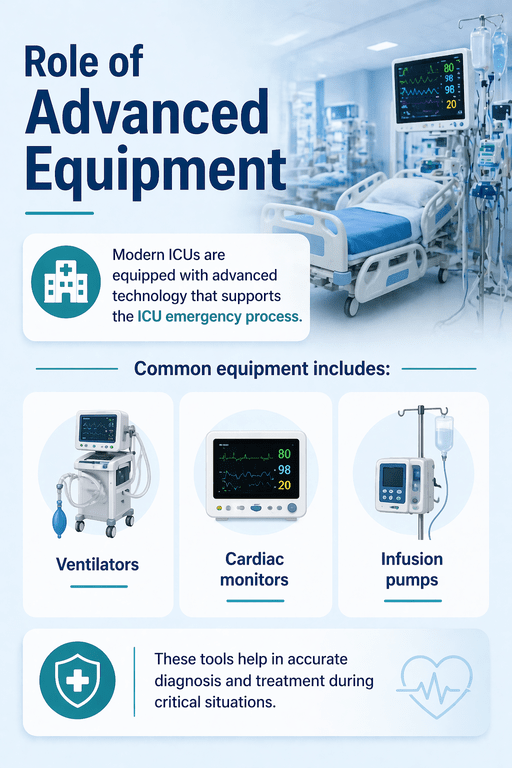
Modern ICUs are equipped with advanced technology that supports the ICU emergency process.
Common equipment includes:
- Ventilators
- Cardiac monitors
- Infusion pumps
These tools help in accurate diagnosis and treatment during critical situations.
Continuous Monitoring After Initial 10 Minutes
Even after the first 10 minutes, the ICU emergency process continues. The patient is closely monitored, and treatment is adjusted based on their response.
Further tests and procedures may be conducted to understand the underlying condition.
Emotional Support for Patients and Families
Emergency situations can be stressful for both patients and their families. Providing emotional support is an important part of the overall care process.
Clear communication and reassurance help reduce anxiety during the ICU emergency process.
Why the First 10 Minutes Are Critical
The first 10 minutes in the ICU are often referred to as the “golden minutes.” Quick action during this time can:
- Save lives
- Prevent complications
- Improve recovery outcomes
This highlights the importance of an efficient ICU emergency process.
Common Conditions Requiring Emergency ICU Admission
Patients may be admitted to the ICU for various reasons, such as:
- Heart attack
- Stroke
- Severe injuries
- Respiratory failure
In all these cases, the ICU emergency process ensures immediate care and stabilization.
How Preparation Improves Outcomes
Preparation is one of the most important factors that ensures the success of the ICU emergency process. Hospitals follow strict protocols and guidelines to make sure that medical teams are always ready to handle emergencies. These protocols are carefully designed to standardize the ICU emergency process and ensure that every patient receives consistent and high-quality care.
Regular training and emergency drills are conducted to improve the efficiency of the ICU emergency process. These drills help healthcare professionals practice their roles, improve coordination, and respond quickly during real situations. When teams are well-trained, they can execute the ICU emergency process more effectively, reducing the chances of errors.
Updated medical guidelines also play a crucial role. As medical science evolves, hospitals continuously update their procedures to improve patient care. This ensures that the ICU emergency process follows the latest standards and best practices.
Another important factor is the availability of advanced equipment. Well-equipped ICUs support the ICU emergency process by providing accurate monitoring and immediate treatment options. This allows healthcare professionals to act quickly and make informed decisions.
Proper preparation not only improves response time but also enhances patient outcomes. A well-prepared team can handle complex situations more confidently, making the ICU emergency process smoother and more effective.
Final Thoughts
The first 10 minutes of ICU admission are extremely critical for saving lives and stabilizing patients. A well-organized ICU emergency process ensures that every step, from initial assessment to immediate treatment, is carried out quickly and efficiently. These early actions can make a significant difference in the patient’s recovery and overall outcome.
The ICU emergency process is not just about medical procedures—it is about coordination, speed, and precision. Each step is carefully planned to address life-threatening conditions and provide the best possible care. Understanding the ICU emergency process helps people appreciate the dedication and expertise of healthcare professionals who work tirelessly during emergencies.
In addition, the effectiveness of the ICU emergency process depends on proper systems, trained staff, and advanced equipment. When all these elements work together, patients receive timely and accurate care, improving their chances of survival and recovery.
In the end, the ICU emergency process plays a vital role in critical care. By focusing on rapid response, teamwork, and continuous monitoring, it ensures that patients receive the immediate attention they need. With strong preparation and efficient execution, the ICU emergency process becomes a powerful tool in saving lives and improving healthcare outcomes.