
Infertility is a common issue affecting almost 1 in 6 people across the globe. While it turns out to be a psychologically stressful issue for couples, it’s imperative to undergo a fertility test for a comprehensive diagnosis. A proper understanding of the fertility test process helps patients understand what exactly to expect during the process.
In this comprehensive guide, we have comprehensively covered different aspects of fertility test for women and men. Read on to understand what happens during a visit to a fertility specialist.
What is Fertility Testing?

Fertility testing is a comprehensive evaluation carried out to diagnose the causes of infertility in both men and women. This process involves several tests that evaluate different aspects of reproductive health.
At the outset, couples should understand that infertility isn’t solely a female condition. Around 40% to 50% of infertility cases are related to male issues, while a combination of both male and female infertility problems leads to complications in 20% to 30% of the cases.
In case a woman under the age 35 fails to conceive in spite of having unprotected intercourse over 12 months, doctors advise undergoing a female fertility test. Those above 35 should get their fertility tested if they fail to conceive in 6 months despite having regular intercourse.
The American Society for Reproductive Medicine (ASRM) has established certain recommendations and guidelines for fertility testing and treatment.
What To Expect During Fertility Testing?
During the testing process, the fertility specialist will ask several questions related to your reproductive health. Some of the common ones include:
- Your medical record, including surgeries and any long-term conditions;
- The medicines you take;
- Whether you take caffeine, drugs, alcohol, or smoke cigarettes;
- Whether you had contact with chemicals, radiation, or toxins;
- The frequency of having intercourse;
- If you use birth control pills;
- If you have STIs;
- Whether you have any other problem during intercourse.
Fertility Test For Men

The fertility test for men starts with a detailed examination of the medical history along with a physical exam. The main test is carried out to evaluate male fertility, where a home semen analysis or laboratory semen analysis is carried out. This test evaluates the quality and quantity of sperm. Doctors evaluate factors like sperm count, motility (movement), and morphology (shape) to determine whether or not they are within their normal ranges.
Obstructive and Nonobstructive Infertility
A male fertility test helps in determining whether the issue is obstructive or nonobstructive. If the reproductive tract in males has a block that prevents sperm from flowing out, it is known as obstructive infertility.
On the other hand, if the issue arises from the quality or production of sperm, or its ability to fertilize a female, it is known as non obstructive infertility.
Infertility in males is also caused due to a generic irregularity called azoospermia, a condition characterized by the absence of sperm. It can also be caused by hormone imbalance, anatomical abnormalities, chemotherapy and radiation.
Different Types Of Fertility Test For Men

In males, the tests carried out to detect infertility include:
- Semen analysis: Semen analysis gives a clear indication of the male reproductive health, including sperm count, semen volume, motility, and shape.
- Blood tests: Doctors recommend blood test to check the level of reproductive hormones in males, including testosterone. Imbalances in hormones can lead to low sperm counts, resulting in lower sex drive and erectile dysfunction.
- Urine tests: After ejaculation, urine tests are carried out to determine if a male is experiencing retrograde ejaculation, a condition where the semen enters the bladder and doesn’t get ejaculated.
- Transrectal ultrasound: Reputed hospitals also carry out transrectal ultrasounds to identify blockages in tubes through which semen flows out of the system. This test can also detect issues with the prostate, like benign prostatic hyperplasia, where the size of the prostate increases.
It’s recommended to go for a fertility test together with your partner to detect underlying complications in both of you.
Fertility Test for Women
Fertility test for women involves a wide range of medical examinations to evaluate different aspects of reproductive health in females. Currently, patients use ovulation predictor kits to carry out primary tests which help in determining if ovulation is taking place. If it happens, the kit determines when it takes place. Also, the fertility specialist evaluates the menstrual cycle to identify any irregularities that might affect fertility.
Different Types Of Fertility Test For Women
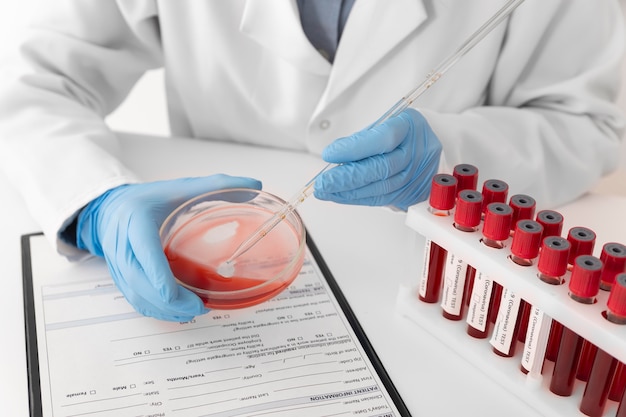
From hormone tests to blood tests, different examinations are carried out in women before the fertility treatment process starts.
-
- Follicle stimulating hormone (FSH): The hormone FSH stimulates the fertile growth of the follicle that contains the egg. Women with amenorrhoea, or no periods at all, may have this hormone in very low quantities.
- Luteinising hormone (LH): The luteinizing hormone LH stimulates the growth of the follicle containing the fertile egg before the ovulation process starts. In women having no periods or irregular periods, LH might be present in normal or high quantities.
- Prolactin (PRL): PRL is usually present in high quantities during pregnancy since it has a crucial role to play in preparing women for breastfeeding.
- Thyrotrophin (TSH): A TSH test helps to determine whether the thyroid gland is underactive, which can cause irregular periods in women.
- Androgens: Women with issues with ovulation or PCOS may have higher levels of androgen.
- Anti-Mullerian Hormone (AMH): Testing the anti müllerian hormone helps in determining the number of remaining eggs. It is actually the ovarian reserve test that is necessary to find out the antral follicle count.
Moreover, ovulation predictor kits are used to carry out ovulation tests, while home make fertility test options are also available.
Tests of Reproductive Organs
Apart from carrying out these tests, the fertility specialist also examines the uterus and fallopian tubes through different tests to detect potential structural abnormalities that may lead to complications.
Hysterosalpingogram (HSG)
HSG, also known as a tubogram, produces a sequence of X-rays of the uterus and fallopian tubes. After the fertility specialist injects liquid dye through the vagina, the test is carried out. There’s another method where air and saline are used in the test. It helps in determining whether the fallopian tubes are blocked or the uterus has any defect. Usually, the HSG test is carried out after the menstrual period.
Transvaginal Ultrasound
In this process, ultrasound is used to examine images of the uterus and ovaries. Fertility specialists use Transvaginal ultrasound to detect potential problems.
Hysteroscopy
Hysteroscopy is a process where a thin and flexible tube with a camera attached to the end is inserted through the cervix into the uterus. This helps in checking underlying problems and collecting tissue samples.
Conclusion
Fertility testing is essential to identify and address different causes of infertility. Based on the symptoms and condition of the patient, doctors may recommend laboratory or home fertility test. With the right approach and timely attention from experts, couples can alleviate infertility issues and embrace their parenthood.
Consider reaching out to the fertility specialists at Santokh Hospital. Seasoned gynaecologists and fertility experts are working with us use advanced diagnostic tools for accurate fertility tests and pregnancy testing and recommend effective treatments. Realize your dream of parenthood with proper treatment from us. Schedule a consultation or book your fertility test.